Disse Sied is noch nich översett. Se kiekt de engelsche Originalversion an.
Quantum algorithms: Grover Search and applications
Atsushi Matsuo (May 10, 2024)
Download the pdf of the original lecture. Note that some code snippets might become deprecated since these are static images.
Approximate QPU time to run this experiment is 2 seconds.
1. Introduction to Grover's algorithm
This notebook is the fourth in a series of lectures on the Path to Utility in Quantum Computing. In this notebook, we will learn about Grover's algorithm.
Grover's algorithm is one of the most well-known quantum algorithms due to its quadratic speedup over classical search methods. In classical computing, searching an unsorted database of items requires time complexity, meaning that in the worst case, one might have to examine each item individually. However, Grover's algorithm allows us to achieve this search in time, leveraging the principles of quantum mechanics to identify the target item more efficiently.
The algorithm uses amplitude amplification, a process that increases the probability amplitude of the correct answer state in a quantum superposition, allowing it to be measured with higher probability. This speedup makes Grover's algorithm valuable in various applications beyond simple database search, especially when the dataset size is large. Detailed explanations of the algorithm is provided in the Grover's algorithm notebook.
The Basic Structure of Grover's Algorithm
Grover's algorithm comprises four main components:
- Initialization: Setting up the superposition over all possible states.
- Oracle: Applying an oracle function that marks the target state by flipping its phase.
- Diffusion Operator: Applying a series of operations to amplify the probability of the marked state.
Each of these steps plays a critical role in making the algorithm work efficiently. Detailed explanations for each step are provided later.
2. Implementing Grover's Algorithm
2.1 Preparation
Import the necessary libraries and set up the environment for running the quantum circuit.
# Added by doQumentation — required packages for this notebook
!pip install -q qiskit qiskit-aer qiskit-ibm-runtime
%config InlineBackend.figure_format = 'svg' # Makes the images look nice
# importing Qiskit
from qiskit import QuantumCircuit, ClassicalRegister, QuantumRegister

# import basic plot tools
from qiskit.visualization import plot_histogram
Step 1: Map problem to quantum circuits and operators
Consider a list of 4 elements, where our goal is to identify the index of an element that meets a specific condition. For instance, we want to find the index of the element equal to 2. In this example, the quantum state represents the index of the element that satisfies this condition, as it points to the position where the value 2 is located.
Step 2: Optimize for target hardware
1: Initialization
In the initialization step, we create a superposition of all possible states. This is achieved by applying a Hadamard gate to each qubit in an n-qubit register, which will result in an equal superposition of states. Mathematically, this can be represented as:
where is the total number of possible states. We also change the state of the ancilla bit to .
def initialization(circuit):
    # Initialization
    n = circuit.num_qubits
    # For input qubits
    for qubit in range(n - 1):
        circuit.h(qubit)
    # For the ancilla bit
    circuit.x(n - 1)
    circuit.h(n - 1)
    circuit.barrier()
    return circuit
n = 2
qr = QuantumRegister(n, "q")
anc = QuantumRegister(1, "ancillary")
initialization_circuit = QuantumCircuit(qr, anc)

initialization(initialization_circuit)
initialization_circuit.draw(output="mpl", idle_wires=False)

2: Oracle
The oracle is a key part of Grover's algorithm. It marks the target state by applying a phase shift, typically flipping the sign of the amplitude associated with that state. The oracle is often problem-specific and constructed based on the criteria for identifying the target state. In mathematical terms, the oracle applies the following transformation:
This phase flip is achieved by applying a negative sign to the amplitude of the target state via phase kickback.
def oracle(circuit):
    circuit.x(1)
    circuit.ccx(0, 1, 2)
    circuit.x(1)
    circuit.barrier()
n = 2
qr = QuantumRegister(n, "q")
anc = QuantumRegister(1, "ancillary")
oracle_circuit = QuantumCircuit(qr, anc)

oracle(oracle_circuit)
oracle_circuit.draw(output="mpl", idle_wires=False)

3: Diffusion Operator
The amplitude amplification process is what differentiates Grover's algorithm from a classical search. After the oracle has marked the target state, we apply a series of operations that increase the amplitude of this marked state, making it more likely to be observed upon measurement. This process is achieved through the Diffusion operator, which effectively performs an inversion about the average amplitude. The mathematical operation is as follows:
where is the diffusion operator, is the identity matrix, and is the equal superposition state. The combination of the oracle and the diffusion operator is applied approximately times to achieve maximum probability for measuring the marked state.
def diffusion(circuit):
    input_qubits = circuit.num_qubits - 1
    circuit.h(range(0, input_qubits))
    circuit.x(range(0, input_qubits))
    circuit.h(input_qubits - 1)
    circuit.mcx([i for i in range(0, input_qubits - 1)], input_qubits - 1)
    circuit.h(input_qubits - 1)
    circuit.x(range(0, input_qubits))
    circuit.h(range(0, input_qubits))
    circuit.barrier()
n = 2
qr = QuantumRegister(n, "q")
anc = QuantumRegister(1, "ancillary")
diffusion_circuit = QuantumCircuit(qr, anc)

diffusion(diffusion_circuit)
diffusion_circuit.draw(output="mpl", idle_wires=False)

2.2 A 2-qubit Grover search example.
n = 2
qr = QuantumRegister(n, "q")
anc = QuantumRegister(1, "ancillary")
meas = ClassicalRegister(3, "meas")
grover_circuit = QuantumCircuit(qr, anc, meas)
# the number of iterations
num_iterations = 1
# Let's do Grover search
initialization(grover_circuit)

for i in range(0, num_iterations):
    oracle(grover_circuit)
    diffusion(grover_circuit)

# Clear the ancilla bit
grover_circuit.h(n)
grover_circuit.x(n)
grover_circuit.measure_all(add_bits=False)

grover_circuit.draw(output="mpl", idle_wires=False)

2.3 Experiment with Simulators
Step 3: Executing the circuit.
from qiskit_aer import AerSimulator
from qiskit_ibm_runtime import Sampler
from qiskit.transpiler.preset_passmanagers import generate_preset_pass_manager

# Define backend
backend = AerSimulator()

# Transpile to backend
pm = generate_preset_pass_manager(backend=backend, optimization_level=1)
isa_qc = pm.run(grover_circuit)

# Run the job
sampler = Sampler(mode=backend)
job = sampler.run([isa_qc])
result = job.result()
Step 4: Post-processing the results.
# Print the results
counts = result[0].data.meas.get_counts()
print(counts)

# Plot the counts in a histogram
plot_histogram(counts)
{'001': 1024}

We got the correct answer . Note that be careful with the order of qubits
3. Experiment with Real Devices
Step 2: Optimize for target hardware
from qiskit_ibm_runtime import QiskitRuntimeService

service = QiskitRuntimeService()
real_backend = service.backend("ENTER-QPU-NAME-HERE")
# You can also identify the least busy device

real_backend = service.least_busy(simulator=False, operational=True)
print("The least busy device is ", real_backend)
# Transpile the circuit into basis gates executable on the hardware
from qiskit.transpiler.preset_passmanagers import generate_preset_pass_manager

pm = generate_preset_pass_manager(backend=real_backend, optimization_level=1)
target_circuit = pm.run(grover_circuit)

target_circuit.draw(output="mpl", idle_wires=False)
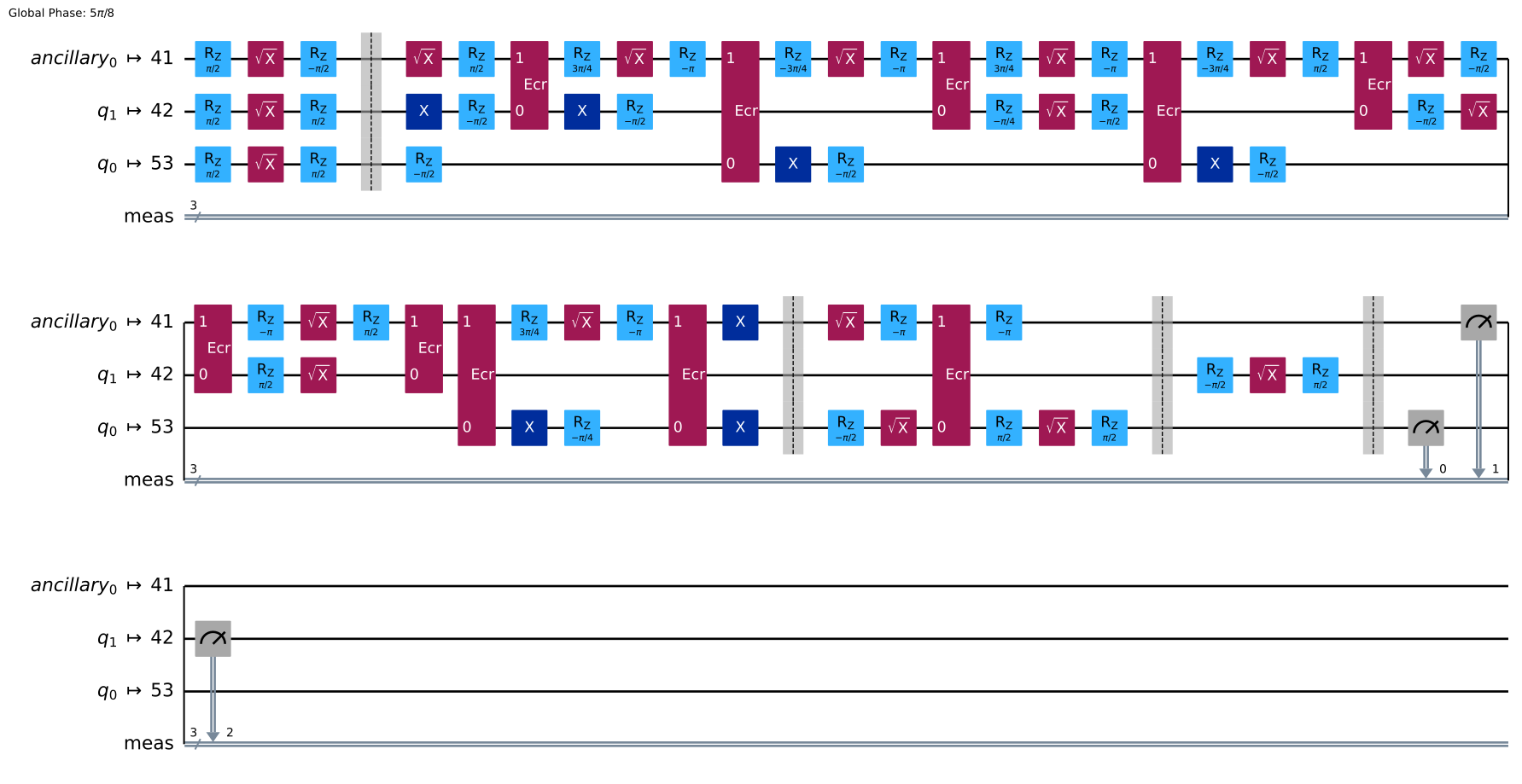
By transpiling the circuit, it was converted to a circuit using the native basis gates of the device.
Step 3: Executing the circuit.
sampler = Sampler(real_backend)
job_real = sampler.run([target_circuit])
job_id = job_real.job_id()
print("job id:", job_id)
job id: cw69csv19rzg0080yfkg
# Check the job status
job_real.status()
'QUEUED'
# If the Notebook session got disconnected you can also check your job status
# by running the following code
job_real = service.job(job_id)  # Input your job-id between the quotations
job_real.status()
'DONE'
# Execute after job has successfully run
result_real = job_real.result()
print(result_real[0].data.meas.get_counts())
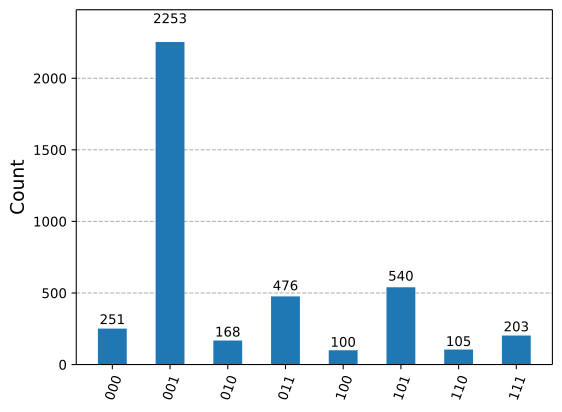
{'101': 540, '001': 2253, '011': 476, '000': 251, '110': 105, '100': 100, '010': 168, '111': 203}
Step 4: Post-processing the results.
plot_histogram(result_real[0].data.meas.get_counts())
4. A 3-qubit Grover Search
Now, let's try a 3-qubit Grover search example.
n = 3
qr = QuantumRegister(n, "q")
anc = QuantumRegister(1, "ancilla")
grover_circuit = QuantumCircuit(qr, anc)
# the number of iterations
num_iterations = 2
def oracle(circuit):
    circuit.mcx([0, 1, 2], 3)
    circuit.barrier()
This time, is the "good" state.
# Let's do Grover search
initialization(grover_circuit)

for i in range(0, num_iterations):
    oracle(grover_circuit)
    diffusion(grover_circuit)

# Clear the ancilla bit
grover_circuit.h(n)
grover_circuit.x(n)

grover_circuit.draw(output="mpl", idle_wires=False)

grover_circuit.measure_all()

# Define backend
backend = AerSimulator()

# Transpile to backend
pm = generate_preset_pass_manager(backend=backend, optimization_level=1)
isa_qc = pm.run(grover_circuit)

# Run the job
sampler = Sampler(backend)
job = sampler.run([isa_qc], shots=1024)
result = job.result()

# Print the results
counts = result[0].data.meas.get_counts()
print(counts)

# Plot the counts in a histogram
plot_histogram(counts)
{'0111': 977, '0100': 11, '0001': 8, '0000': 8, '0011': 5, '0010': 12, '0110': 3}
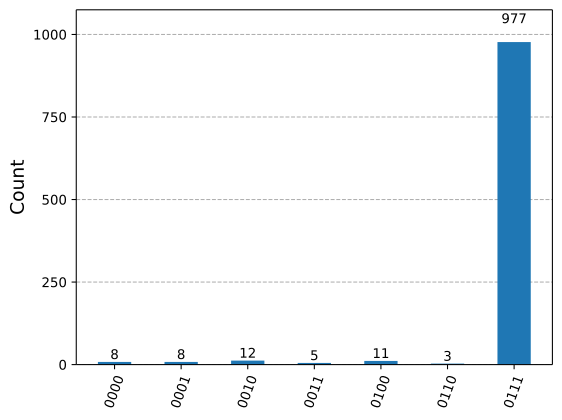
is observed with the highest probability, as expected. Note that two iterations are optimal in this case. However, the probability of obtaining the correct answer is not 100%, which is usual in Grover's search.
What happens if we iterate 3 times?
Now, let's try iterating 3 times.
n = 3
qr = QuantumRegister(n, "q")
anc = QuantumRegister(1, "ancillary")
grover_circuit = QuantumCircuit(qr, anc)
# the number of iterations
num_iterations = 3
# Let's do Grover search
initialization(grover_circuit)

for i in range(0, num_iterations):
    oracle(grover_circuit)
    diffusion(grover_circuit)

# Clear the ancilla bit
grover_circuit.h(n)
grover_circuit.x(n)

grover_circuit.draw(output="mpl", idle_wires=False, fold=-1, scale=0.5)

grover_circuit.measure_all()

# Define backend
backend = AerSimulator()

# Transpile to backend
pm = generate_preset_pass_manager(backend=backend, optimization_level=1)
isa_qc = pm.run(grover_circuit)

# Run the job
sampler = Sampler(backend)
job = sampler.run([isa_qc], shots=1024)
result = job.result()

# Print the results
counts = result[0].data.meas.get_counts()
print(counts)

# Plot the counts in a histogram
plot_histogram(counts)
{'0010': 88, '0001': 103, '0000': 94, '0111': 334, '0100': 112, '0110': 106, '0101': 99, '0011': 88}
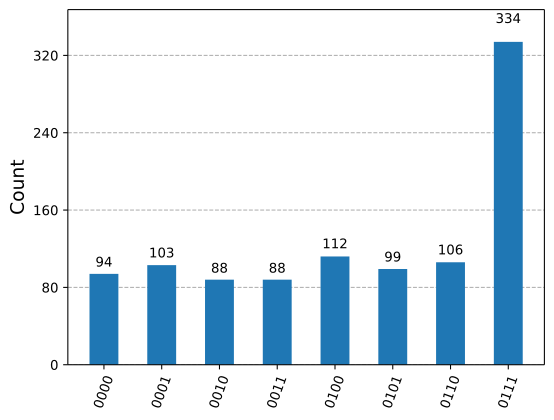
is still observed with the highest probability, though the probability of obtaining the correct answer has slightly decreased.
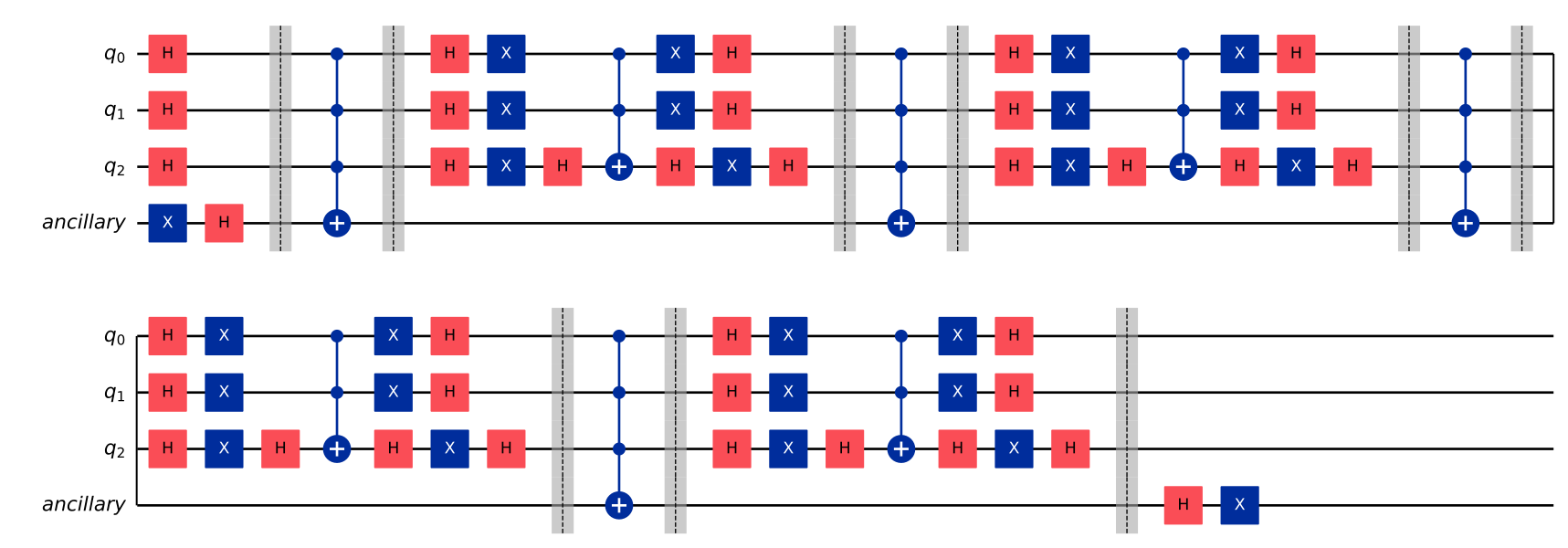
How about 4 times?
Now, let's try iterating 4 times.
n = 3
qr = QuantumRegister(n, "q")
anc = QuantumRegister(1, "ancillary")
grover_circuit = QuantumCircuit(qr, anc)
# the number of iterations
num_iterations = 4
# Let's do Grover search
initialization(grover_circuit)

for i in range(0, num_iterations):
    oracle(grover_circuit)
    diffusion(grover_circuit)

# Clear the ancilla bit
grover_circuit.h(n)
grover_circuit.x(n)

grover_circuit.draw(output="mpl", idle_wires=False, fold=-1, scale=0.5)
grover_circuit.measure_all()

# Define backend
backend = AerSimulator()

# Transpile to backend
pm = generate_preset_pass_manager(backend=backend, optimization_level=1)
isa_qc = pm.run(grover_circuit)

# Run the job
sampler = Sampler(backend)
job = sampler.run([isa_qc])
result = job.result()

# Print the results
counts = result[0].data.meas.get_counts()
print(counts)

# Plot the counts in a histogram
plot_histogram(counts)
{'0110': 127, '0000': 135, '0001': 150, '0101': 164, '0010': 153, '0011': 131, '0100': 150, '0111': 14}
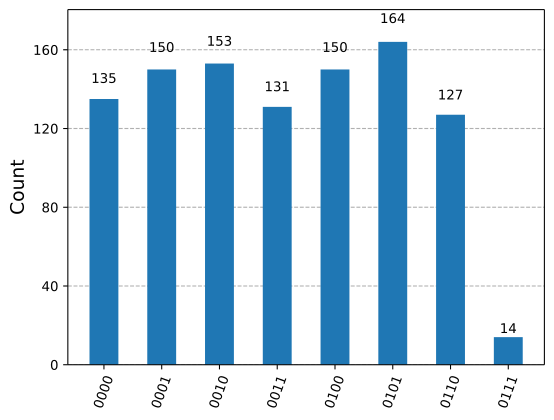
is observed with the lowest probability, and the probability of obtaining the correct answer has decreased further. This demonstrates the importance of choosing the optimal number of iterations for Grover's algorithm to achieve the best results.
# See the version of Qiskit
import qiskit

qiskit.__version__
'2.0.2'